
Trust by design
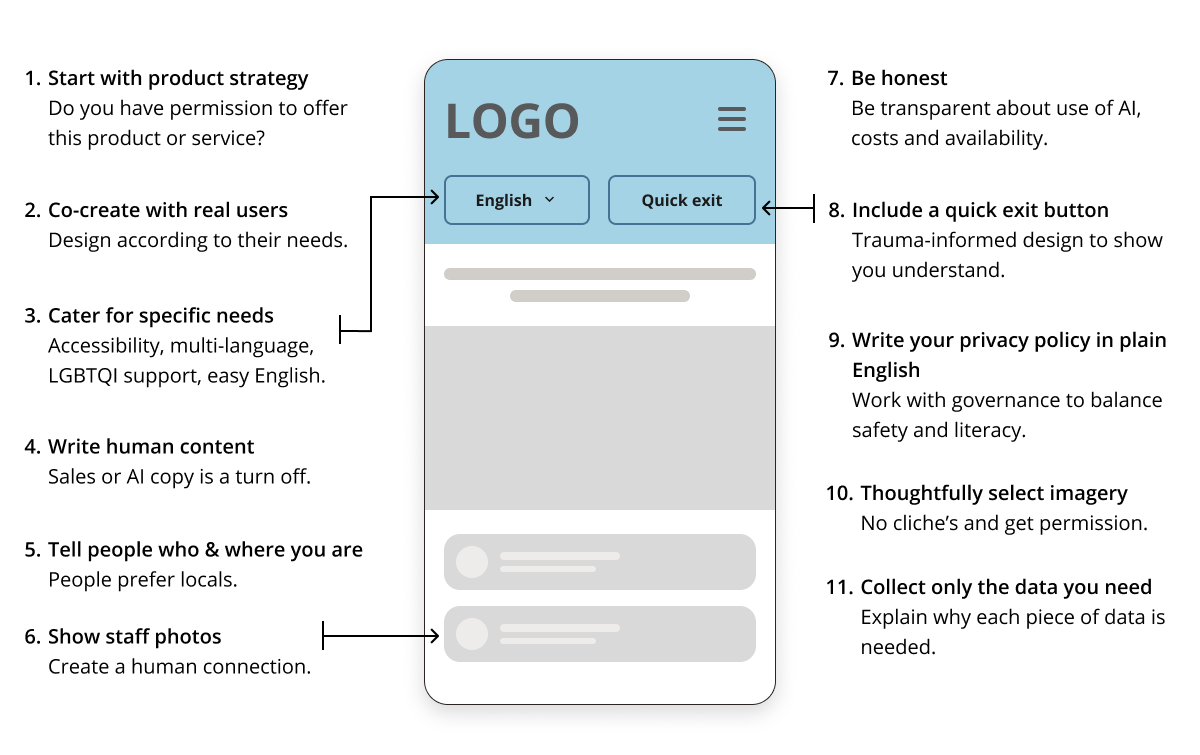
Before AI, building trust with your customers was critical to success and the difference between keeping customers and fostering positive word of mouth. Since AI has entered all parts of customer experience along with all the unknowns that come with it, trust between you and your customer or patient, is more important than ever.
Here are 11 ways to foster trust by your consumers, throughout your digital service.
Trust begins with your product strategy
Do you have permission to offer the product or service? If so, share your ‘why’. This is what people connect with. The older adage by Simon Sinek, still holds true: ‘People don’t buy what you do, they buy why you do it.’Co-create with real users
Follow human-centred design practices by including the people who will actually use your product or service, at the beginning and throughout the design and development of your service. This reduces assumptions and bias and ensures you create something people can and want to use.Cater for specific needs
Understanding your users/consumers/patients will allow you to cater for specific communication needs they might have. Accessibility applies for every digital service and will improve the service for everyone. The audience for your Australian health service WILL be made up of people who are remote, who are disabled, who do not speak English well. But more specifically, which languages are first languages amongst your audience group? Is your service for a vulnerable population or an older population or people who identify as LBGTQI? If so, specifc design considerations might be creating Easy Read content, displaying a recognisable icon to show your support for particular cohorts.Write human content
Write your content and messaging to make sure it sounds human. Sales or AI content is a turn off and is noticed immediately. Consumers want to know there is a person, behind the wording or the service, who relates to them.Tell people who and where you are
This relates to item 1. and 4. above. Who are you and what is your story. And also where are you? People preference services that are in their area and have local knowledge.Show staff photos
This has become a convention on websites, to be able to see profile pictures of people the consumer will be dealing with. Being able to see the people and get their ‘vibe’, helps foster human connection.Be honest
Be transparent about use of AI, costs and availability. Respect people's time spent researching and give them realistic information to help them decide.Include a quick exit feature
Trauma-informed design features such as this are for vulnerable individuals, who face immediate physical, emotional, or social harm if someone unexpectedly catches them browsing sensitive resources.Write you privacy policy in Plain English
These can be written so that readers can actually understand them, without losing legal precision. The Plain English Foundation runs a training course for Lawyers on writing in plain language.Thoughtfully select imagery
Choose images that provide diverse representation and minimise harm, stigma and discrimination. Mindframe published guidelines for image use on sensitive topics. Always get consent and credit image sources.Collect ONLY the data you need
For every data collection form, use a question protocol to determine and plan what data needs to be collected. Each question has a cost (to the business or the user). Explain, on the form, why each piece of data is required and how it will be used and stored. Work with governance to balance security and user experience.
